Eugene, Oregon • 1951 — 1975

Go
Pre.

“To give anything less than your best is to sacrifice the gift.” Steve Prefontaine didn’t just win races — he changed how America ran. This is his story, kept simple.

7NCAA titles
1972Munich Olympics
13U.S. records*
24Years old
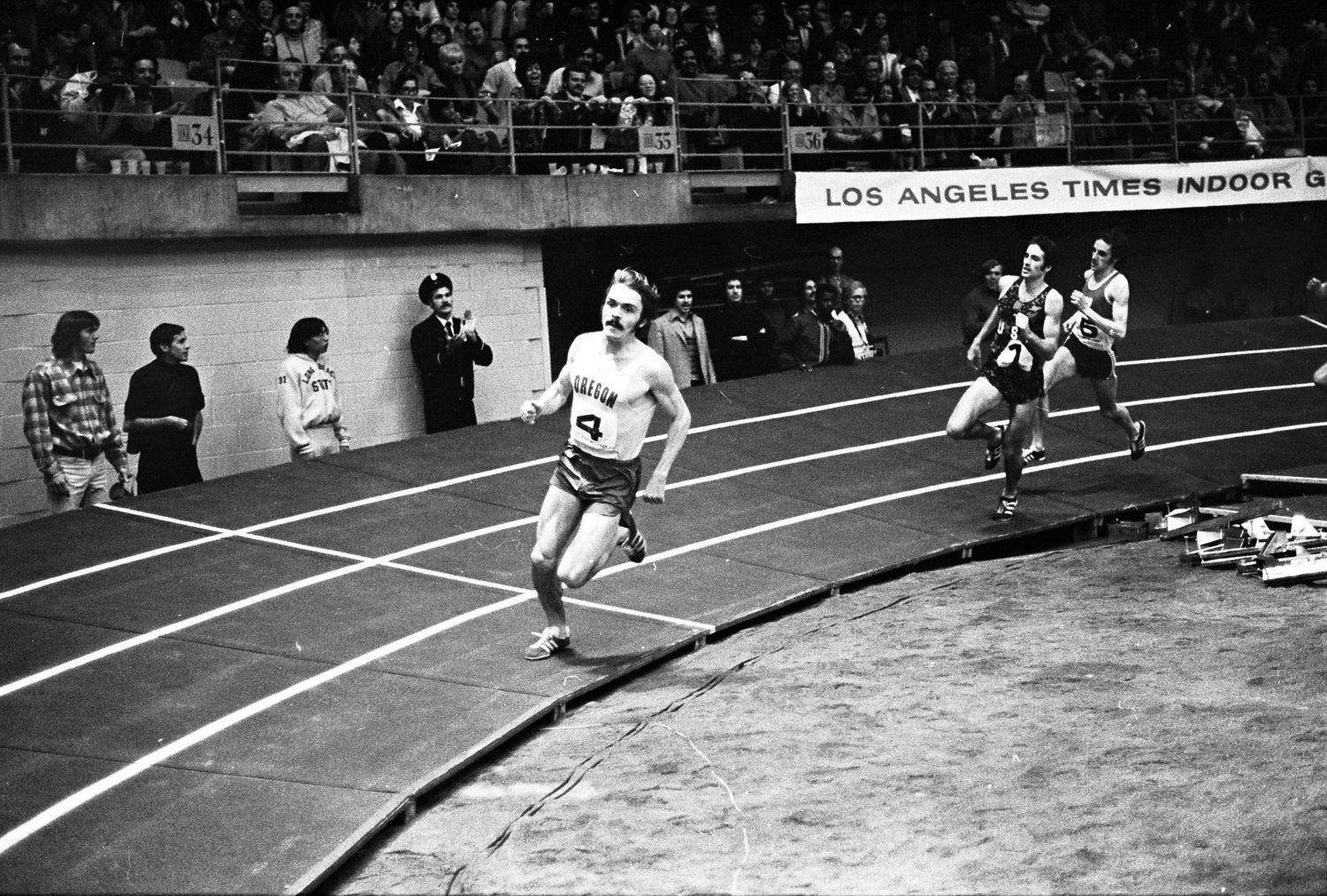
Steve Prefontaine in the Oregon number 4 singlet leading Marty Liquori and Gianni Del Buono in the mile at the 1973 LA Times Indoor Games
PRE AT FULL STRIDE
The mile at the LA Times Indoor Games — Pre leads Marty Liquori, Feb 10, 1973.
1973

Photo: Larry Sharkey / Los Angeles Times (UCLA Library), CC BY 4.0, via Wikimedia Commons

*Records held across distances from 2,000m to 10,000m during his career. Every photo on this page is freely licensed — credits sit with each picture, and the full set is in Photos below.

About Pre

Who is Steve
Prefontaine?

Born in Coos Bay, Oregon, Pre ran for the University of Oregon under Bill Bowerman, packed Hayward Field, and became the face of American distance running — all before 25.

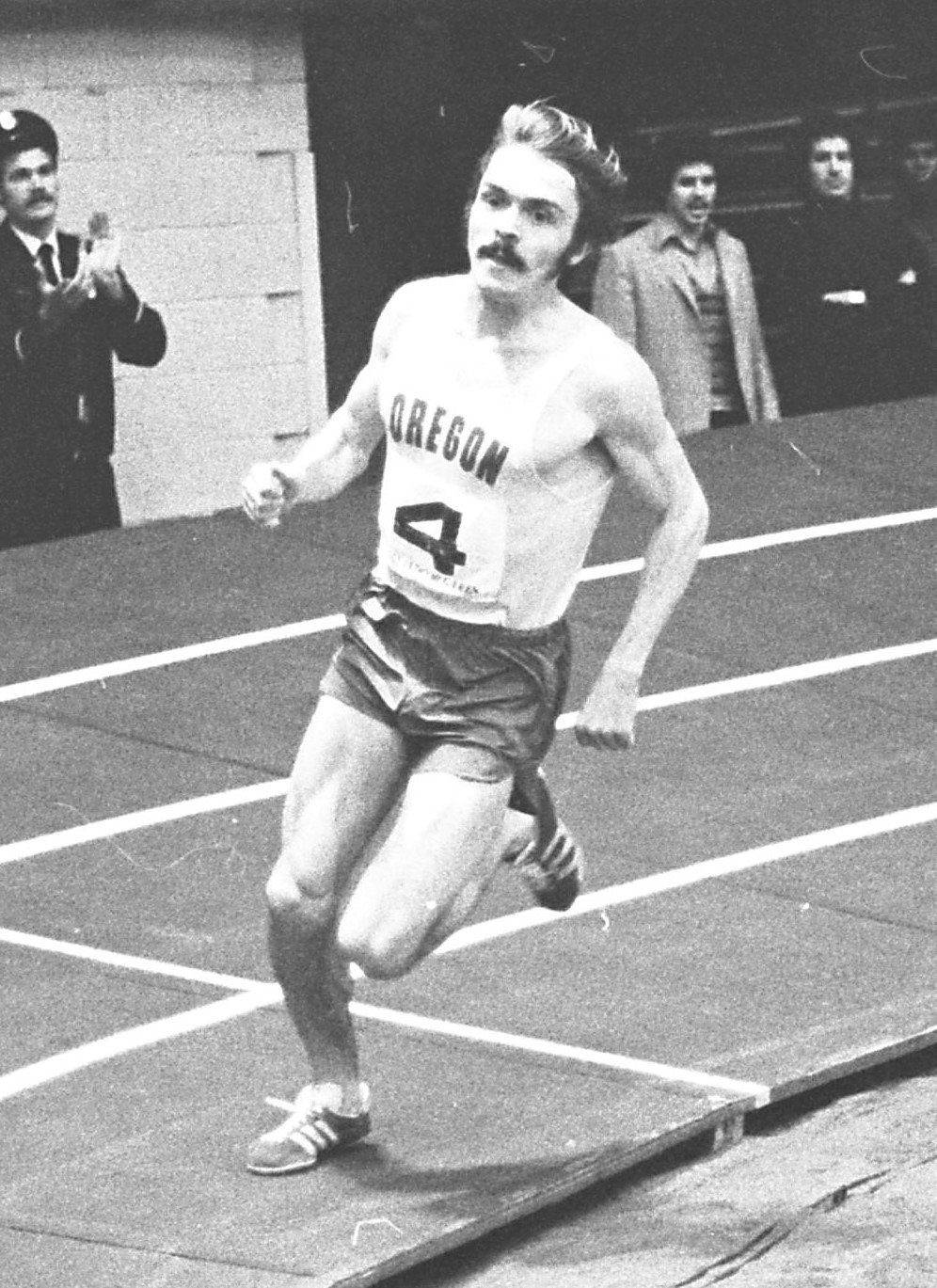
Steve Prefontaine in the Oregon number 4 singlet pulling away in the final turn of the mile at the 1973 LA Times Indoor Games
“Turning it on” — Pre pulls away in the final turn to win the mile in 3:59.2 at the LA Times Indoor Games, Feb 10, 1973, in the Oregon singlet Eugene knew by heart. He won every NCAA championship he contested in cross country and the 3-mile / 5,000m.Photo: Larry Sharkey / Los Angeles Times (UCLA Library), CC BY 4.0, via Wikimedia Commons

He didn’t wait for the last lap. He made the whole race honest.

Most runners sat and kicked. Pre went to the front and dared you to stay with him. That front-running style — fearless, punishing, crowd-electric — is why Hayward Field chanted “Pre! Pre! Pre!” and why runners still quote him on bedroom walls and locker doors.

Off the track he fought for athletes’ rights against the old amateur system and helped seed the culture that became Nike. He died in a car crash in Eugene on May 30, 1975, hours after winning a race at Hayward. Pre’s Rock, where it happened, is still a pilgrimage site.

Coos Bay → EugeneMarshfield HS to University of Oregon
Coach: Bill BowermanLegendary Oregon coach & Nike co-founder
Signature: Front-runner“Pure guts race” — no hiding, no waiting
Legacy: Pre’s RockMemorial on Skyline Blvd, Eugene
1969

Arrives at Oregon

Small-town kid from Coos Bay joins Bowerman’s Ducks and immediately fills the stands.

1972

Munich Olympics

At 21, he leads the Olympic 5,000m final late and finishes 4th in a race for the ages.

1973–74

Record run

Holds American records at every distance from 2,000m to 10,000m. Unbeaten at Hayward at 3 miles / 5,000m.

1975

Last race

Wins at Hayward on May 29. Gone the next morning. The legend only grows from there.

In his words — tap to change
“To give anything less than your best is to sacrifice the gift.”
— Steve Prefontaine
Race Results

Every race.
1967 — 1975.

The full career log — 152 races, from Marshfield High School in Coos Bay to the final win at Hayward Field on May 29, 1975. (AR) = American Record.

152 races 119 wins 13 American Record marks High School 49 · College 70 · Post-College 33

Spellings as in the source list (e.g. Joutsenco, SCJV). One race ended DNF — the 2 Mile at Coca-Cola, London, 9/13/74. Highlighted rows are American Record performances where the source marks (AR); other record marks (NHSR, ORHSR, NCAA R) are shown with their time.

The place

Hayward Field

More than a century of track history on one patch of Eugene ground — from a cow pasture in 1919 to the finest track-only stadium in America. And for five unforgettable years, it was Steve Prefontaine’s house.

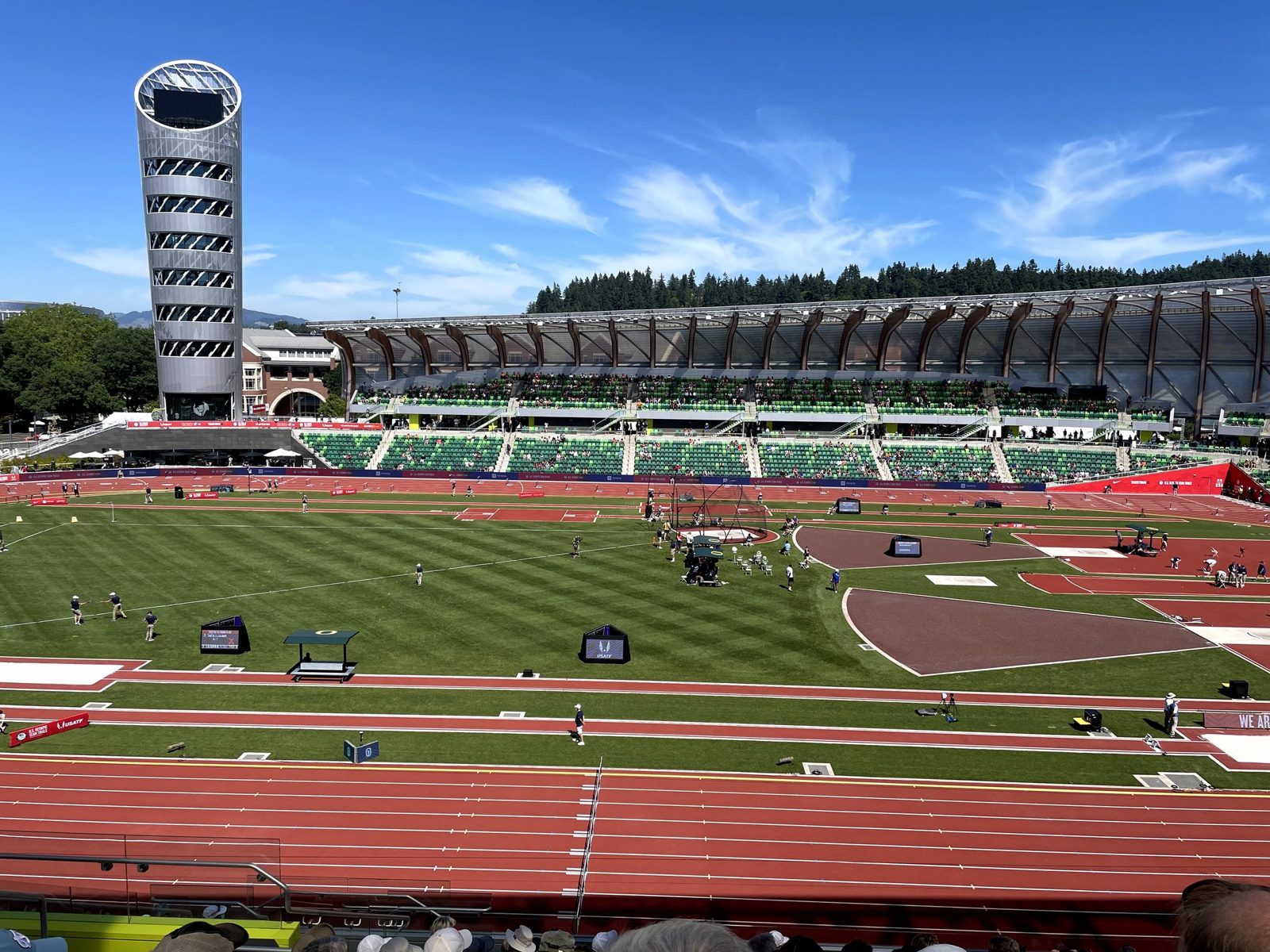
The rebuilt Hayward Field during the 2021 U.S. Olympic Trials — Bowerman Tower rising over the green seats and red nine-lane track
University of Oregon • Eugene

Where the crowd
chanted his name.

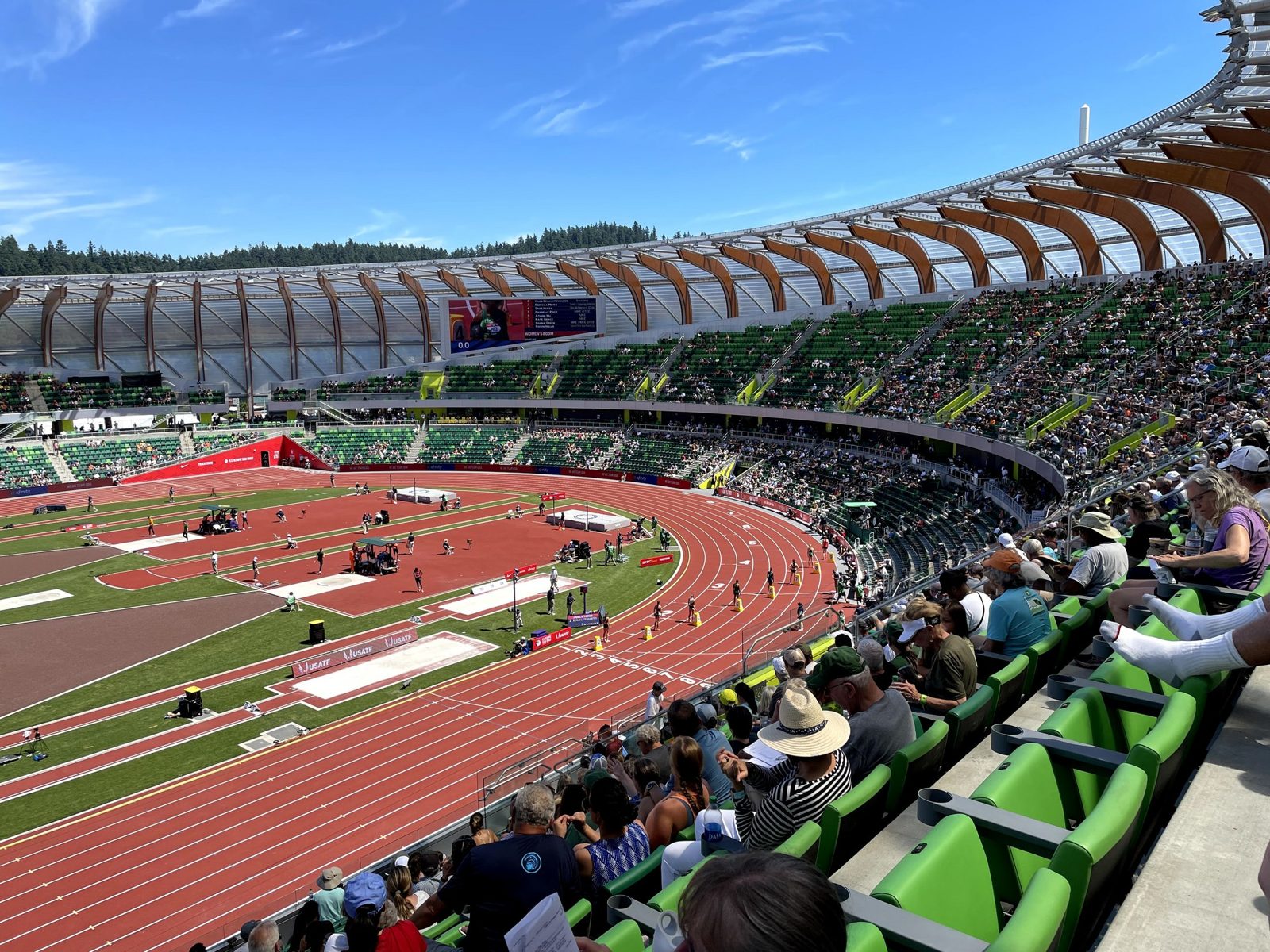
Pre packed this place like nobody before or since. Demolished and rebuilt from 2018, the new Hayward Field keeps the old magic — steep stands, close to the track, loud on purpose.

Open in Maps ↗

The rebuilt Hayward Field at the 2021 U.S. Olympic Trials. Photo: Chris Schiemann, CC BY-SA 4.0, via Wikimedia Commons

From cow pasture to TrackTown’s cathedral

Hayward Field started in 1919 as the University of Oregon’s football stadium, built on an old cow pasture and named for Bill Hayward, the Ducks’ track coach from 1904 to 1947. A six-lane cinder track went in two years later, and the place slowly became something more than a stadium — the beating heart of American distance running.

When football left for Autzen Stadium in 1967, Hayward went track-only. Three years later it got eight lanes and its first all-weather surface — just as a kid from Coos Bay named Steve Prefontaine arrived to make it famous. Over the decades it has hosted NCAA Championships, U.S. Olympic Trials and a long list of American records: the center of “TrackTown USA.”

The rebuild, 2018–2021

After the 2018 NCAA Championships, the 99-year-old stadium was demolished and rebuilt from scratch on the same site — funded entirely by private donations led by Nike co-founder Phil Knight and his wife Penny, reported at roughly $270 million. The new Hayward, designed by SRG Partnership, is built for one sport only: 12,650 permanent seats expandable to about 30,000, a nine-lane track, timber roof beams echoing Oregon’s fir forests, and the nine-story Bowerman Tower topped by a 128-foot observation deck.

It opened with the Hayward Premiere in April 2021, hosted the U.S. Olympic Trials that summer, and in 2022 welcomed the World Athletics Championships — the first ever held on U.S. soil.

A century at Hayward
  • 1919Built as Oregon’s football stadium on an old cow pasture; named for track coach Bill Hayward.
  • 1921Six-lane cinder track installed — Hayward becomes the home of Oregon track & field.
  • 1925East Grandstand completed, designed by architect Ellis Lawrence.
  • 1967Football moves to Autzen Stadium; Hayward becomes a track-only facility.
  • 1970Track widened to eight lanes and gets its first all-weather surface.
  • 1975New West Grandstand, funded in part by the Hayward Restoration meets where Pre starred in 1973–74.
  • 2018The 99-year-old stadium is demolished after the NCAA Championships.
  • 2021The rebuilt Hayward Field opens and hosts the U.S. Olympic Trials.
  • 2022Hosts the World Athletics Championships — the first ever on U.S. soil.
12,650Permanent seats, expandable to ~30,000
~$270MPrivate funding, led by Phil & Penny Knight
9 lanesA stadium built for one sport only
2022World Championships — first on U.S. soil

Pre’s place, still

The West Grandstand that rose in 1975 was paid for in part by the Hayward Restoration meets — the races where Pre starred in 1973 and 1974, including his American-record 12:51.4 Restoration win in June 1974 (find it in the Results above). After his death, the meet was renamed the Prefontaine Classic, and it is still one of the world’s great one-day meets. Fans also still leave race bibs and shoes at Pre’s Rock on Skyline Boulevard, where he died — a short run from the track he made famous.

The company

Nike — born
at Oregon

Nike didn’t start in a boardroom. It started at Hayward Field — a coach who couldn’t stop tinkering with shoes, his former miler selling imports out of a car trunk, and the star who put the Swoosh on the map: Steve Prefontaine.

Blue Ribbon Sports • Eugene, Oregon

A coach, a runner,
and $500 each.

Bill Bowerman coached Oregon. Phil Knight ran for him. In 1964 they shook hands, put in $500 apiece, and started importing Japanese running shoes. A decade later their little company had a new name — Nike.

Blue Ribbon Sports: shoes out of a car trunk

On January 25, 1964, Bowerman and Knight founded Blue Ribbon Sports in Eugene as the American distributor for Onitsuka Tiger, the Japanese running-shoe maker. Knight — who borrowed his $500 stake from his father — worked the track-meet circuit, selling Tigers out of his car. Bowerman stayed home coaching Oregon, pulling the imported shoes apart and rebuilding them lighter, with better cushioning and grip, then handing the prototypes to his runners to test.

The partnership worked because each man did what the other couldn’t: Knight ran the business, Bowerman reinvented the product. His cushioned design became the Tiger Cortez in 1966 — a best-seller — and BRS opened its first little retail store that same year in Santa Monica, California. In year one they sold 1,300 pairs for $8,000; within a few years, sales were doubling and doubling again.

1971: a new name, a $35 logo, and a waffle iron

When the deal with Onitsuka fell apart in 1971, Blue Ribbon had to become a brand of its own — fast. First employee Jeff Johnson suggested the name Nike, for the Greek goddess of victory (he said it came to him in a dream; Knight wanted “Dimension Six”). Portland State design student Carolyn Davidson drew the Swoosh for $35 — $2 an hour. Knight’s review: “I don’t love it, but maybe it will grow on me.” In 1983, Nike thanked Davidson with a gold Swoosh ring and 500 shares of stock.

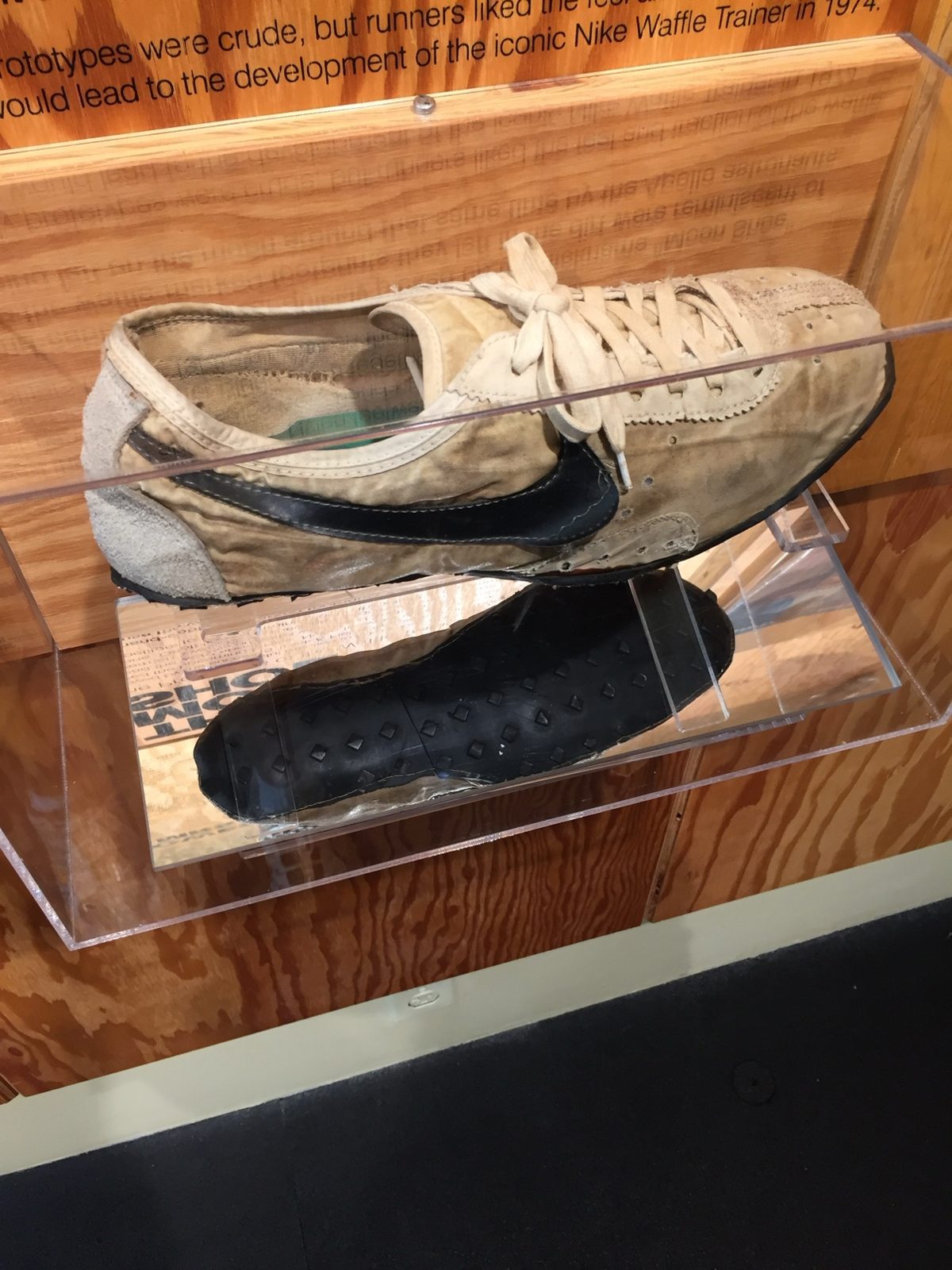
That same year, over breakfast, Bowerman looked at his wife Barbara’s waffle iron and wondered what would happen if you flipped the waffle over: little rubber nubs that grip without spikes, light as air. He poured rubber into the iron — ruining it — and invented the waffle sole. His handmade “Moon Shoe,” named because its tread looked like the Apollo astronauts’ footprints, debuted at the 1972 U.S. Olympic Trials in Eugene, where Knight handed out Nike T-shirts to make the unknown brand impossible to miss. Refined as the Waffle Trainer in 1974, it powered Nike past Adidas to No. 1 in America by 1980 — the year the company went public. Air Jordans and “Just Do It” were still to come. It all traces back to a track coach’s breakfast table.

From trunk to Swoosh
  • 1964Jan 25 — Bowerman & Knight found Blue Ribbon Sports in Eugene, $500 each, to import Onitsuka Tiger shoes.
  • 1966Bowerman’s design becomes the Tiger Cortez; the first BRS retail store opens in Santa Monica.
  • 1971Split with Onitsuka — Blue Ribbon becomes Nike, Inc. on May 30, named by Jeff Johnson for the goddess of victory.
  • 1971Carolyn Davidson draws the Swoosh for $35. Bowerman pours rubber into a waffle iron and invents the waffle sole.
  • 1972The handmade Moon Shoe debuts at the U.S. Olympic Trials in Eugene. Nike sells $3.2 million of shoes that year.
  • 1973Pre goes to work for Nike — the first runner the company signs, its original pitchman and shoe-tester.
  • 1974The Waffle Trainer launches and becomes Nike’s first big hit.
  • 1980Nike passes Adidas as No. 1 in the U.S. and goes public.
  • 1988“Just Do It” launches — three words that grew out of the running culture Pre helped create.
$500Each founder’s stake in 1964 — Knight borrowed his from his dad
$35What Carolyn Davidson billed for the Swoosh in 1971
12 pairsHandmade Moon Shoes Bowerman built for the 1972 Trials
$163,800What Pre’s worn Oregon Waffles sold for at Sotheby’s in 2022

Inside the exhibit at Nike HQ

Photographed by Kurt, 2016
The Moon Shoe in its display case at Nike Headquarters — Bowerman's handmade waffle-soled prototype above a waffle sole
The Moon Shoe — Bowerman’s waffle-soled prototype, on display at Nike Headquarters.Photo by Kurt, Nike Headquarters, 2016
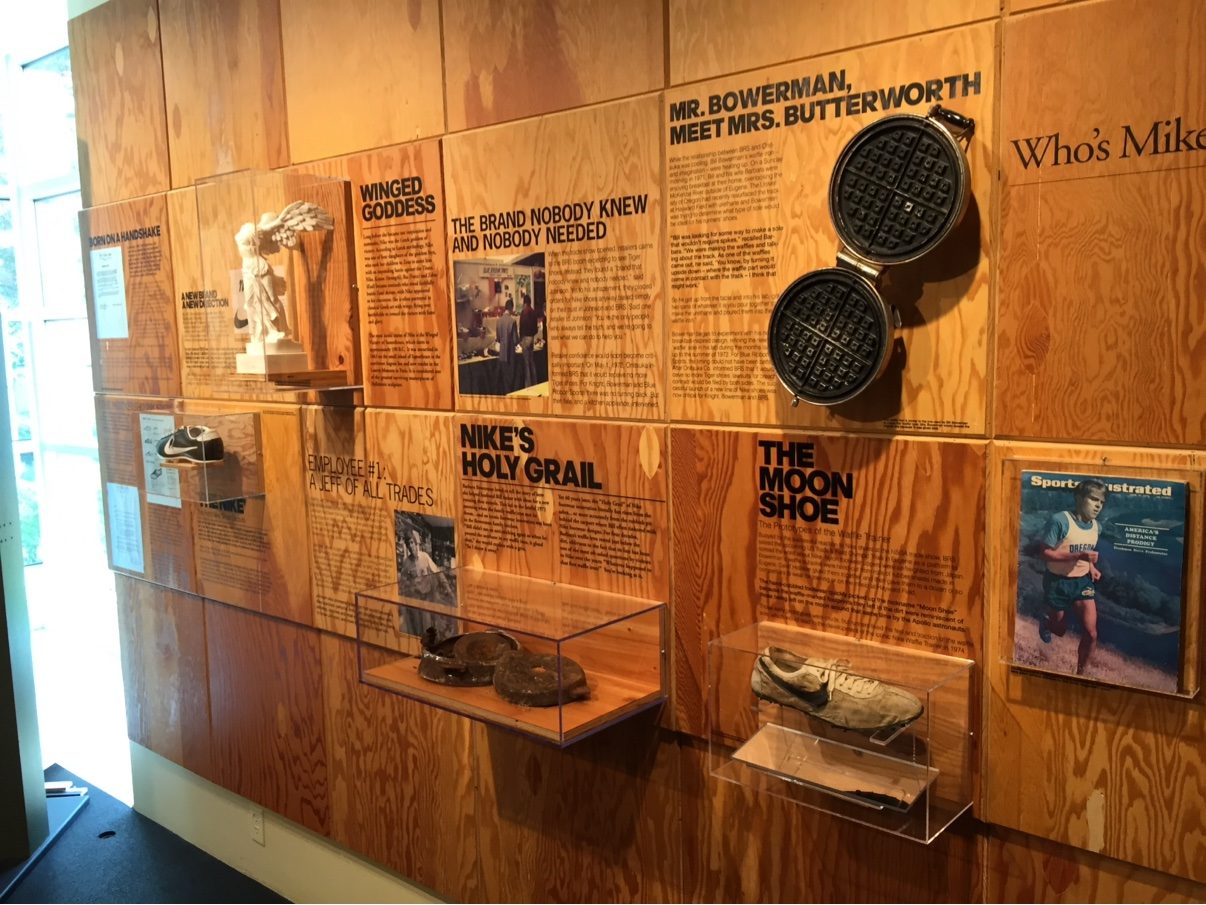
The Nike history wall at Nike Headquarters — wooden panels, Bowerman's waffle iron, the Moon Shoe case and the 1970 Sports Illustrated cover
The Nike history wall — Bowerman’s waffle iron (“Mr. Bowerman, meet Mrs. Butterworth”), the Moon Shoe case, and the 1970 Sports Illustrated cover.Photo by Kurt, Nike Headquarters, 2016
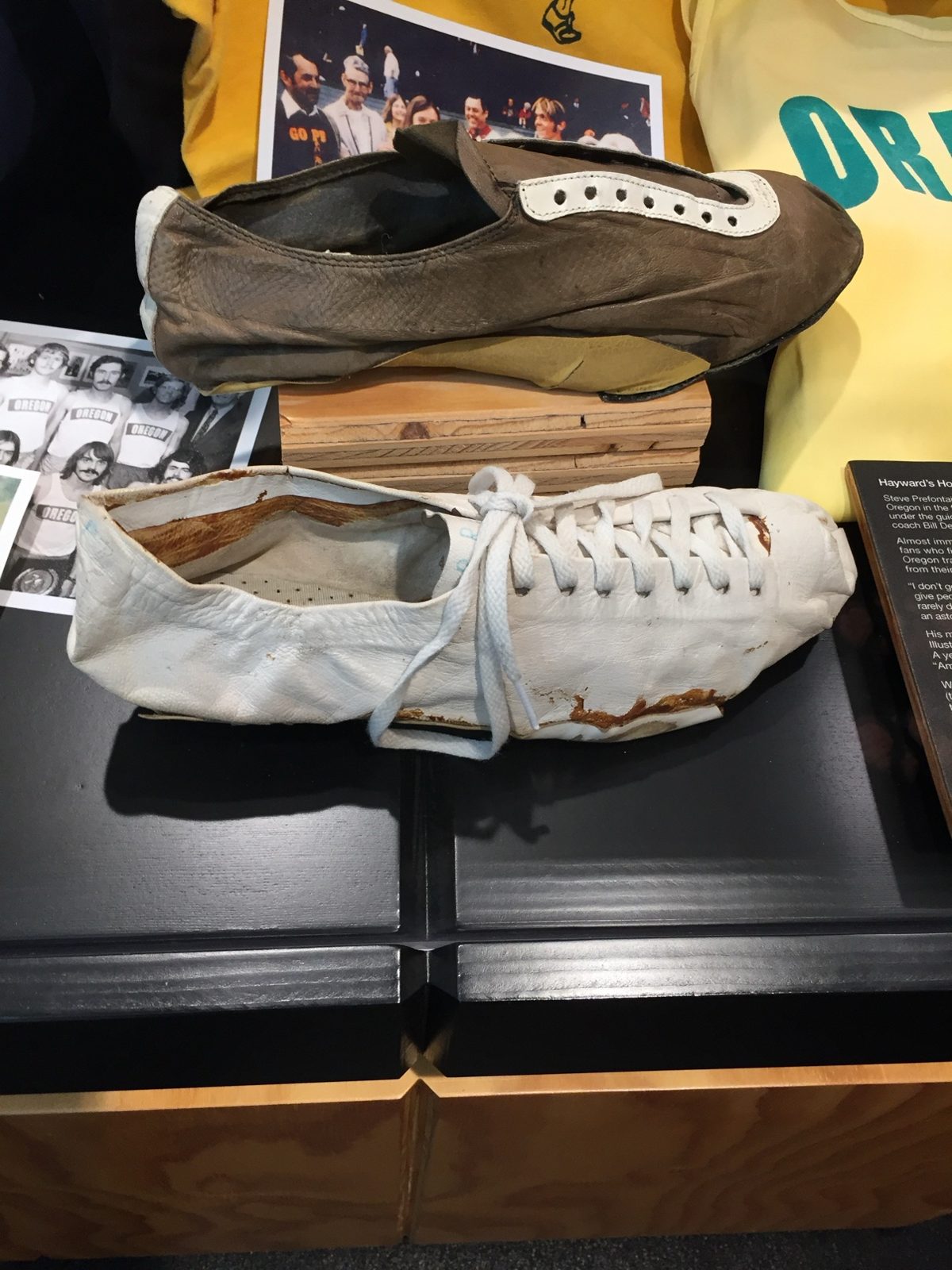
Pre's racing shoes on display at Nike Headquarters — a worn white leather racing shoe and a brown slipper-style shoe
Pre’s racing shoes on display at Nike Headquarters.Photo by Kurt, Nike Headquarters, 2016

Pre put the Swoosh on the map

Nike’s first star wasn’t signed out of a catalog — he was already family. Pre raced in Bowerman’s prototype waffle shoes while still at Oregon, wearing Nikes in competition from 1973, and in 1974 became the first runner to sign with Nike, for $5,000 — the first athlete paid to wear the shoes. Amateur rules barred a straight endorsement, so Nike gave him a job instead: Pre printed business cards calling himself the company’s National Director of Public Affairs, worked the BRS shop in Eugene, and toured schools, clubs and running shops across the Pacific Northwest with early employee Geoff Hollister, jogging with kids and preaching the gospel of running — and of Nike.

His best marketing needed no ads. Pre mailed free pairs with personal letters to his fiercest rivals, daring them to try the upstart brand. His April 9, 1975 letter talked Bill Rodgers into a pair — Rodgers won the Boston Marathon in Nikes twelve days later, in an American-record 2:09:55. That was the template Nike still runs on: win the best athlete, and everyone watching follows. Phil Knight put it simply — Pre “set a tone for this whole company.” Today Prefontaine Hall at Nike headquarters, with Pre’s statue, is where every new Nike employee starts. The kid from Coos Bay died in 1975. The company he fueled never stopped running.

Photos

Pre in
pictures

An arc in pictures, in order — the runner at his peak in 1973, one quiet moment in 1975, the rock on Skyline Boulevard where the running world still goes to remember him, and finally the exhibit Nike keeps for him at its headquarters. Credits sit under each picture.

The runner

1973 — 1975
Steve Prefontaine leading Marty Liquori and Gianni Del Buono in the mile at the 1973 LA Times Indoor Games
1973The mile at the 14th annual LA Times Indoor Games — Pre leads Marty Liquori, in the USA singlet, and Italy’s Gianni Del Buono, February 10.Photo: Larry Sharkey / Los Angeles Times (UCLA Library), CC BY 4.0, via Wikimedia Commons
Close-up of Steve Prefontaine in the Oregon number 4 singlet driving through the final turn of the mile
1973“Turning it on” — the same night, Pre pulls away in the final turn to win the mile in 3:59.2.Photo: Larry Sharkey / Los Angeles Times (UCLA Library), CC BY 4.0, via Wikimedia Commons
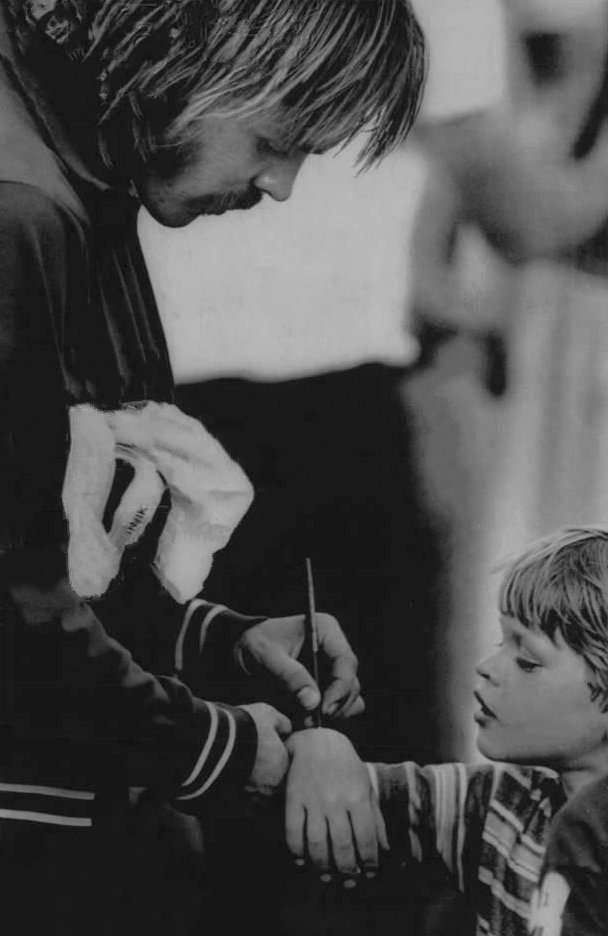
Steve Prefontaine leaning down to sign an autograph for a young fan, 1975
1975The star off the track — Pre signs an autograph for a young fan in 1975, the last year of his life.Photo: Associated Press, public domain, via Wikimedia Commons

The legacy — Pre’s Rock

2007 — 2024

The museum — Pre at Nike HQ

2016

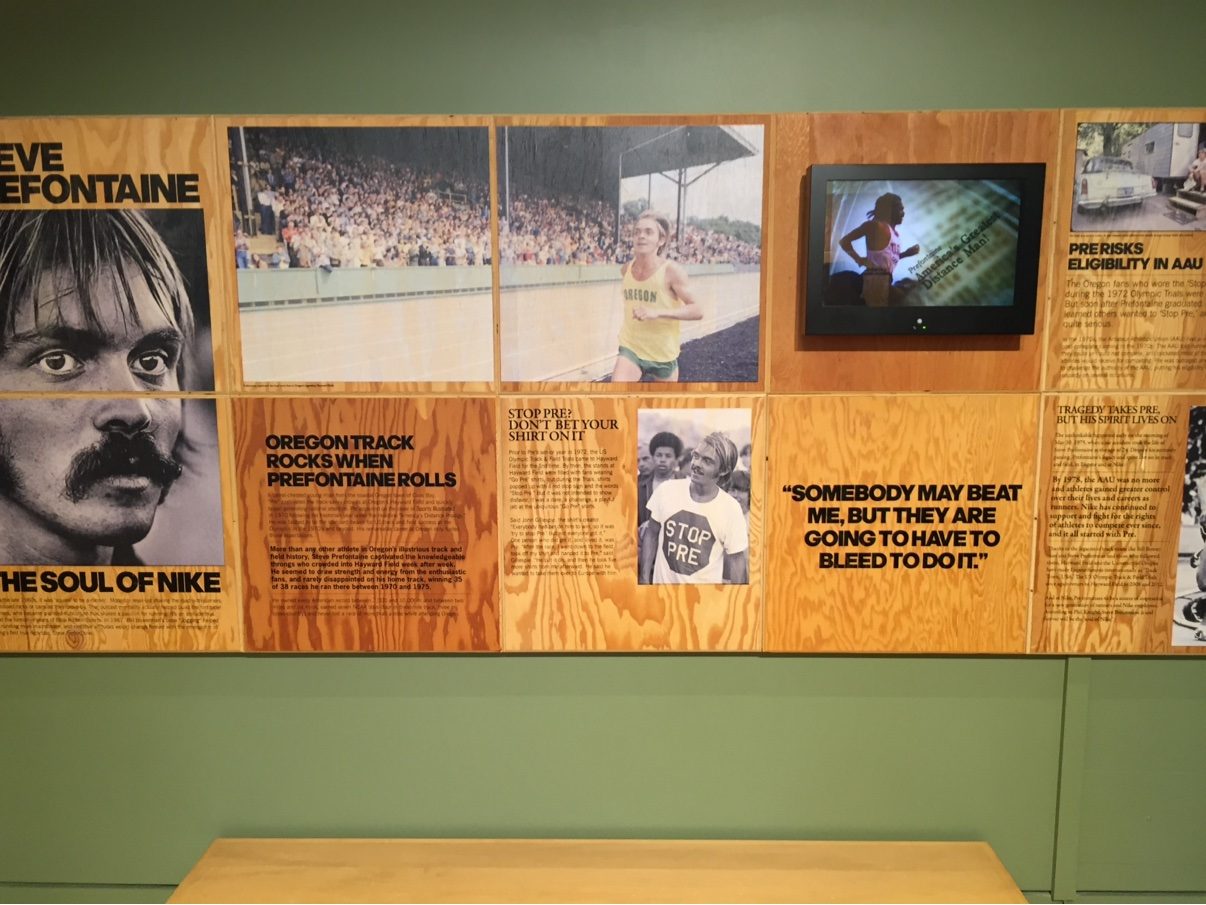
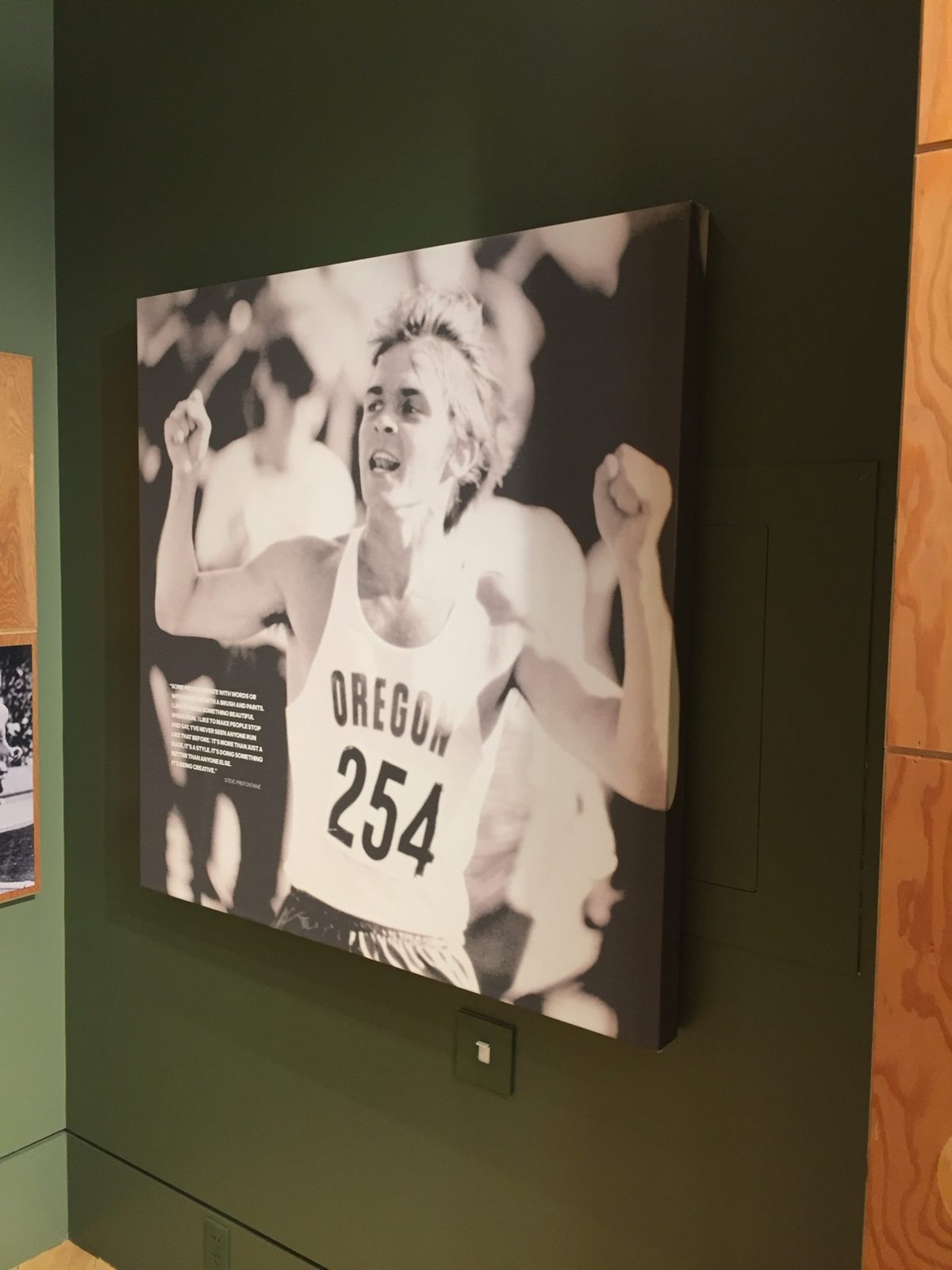
These four are Kurt’s own photographs, taken at the Prefontaine exhibit at Nike Headquarters in 2016 — the company keeps its first star’s story on the walls of Prefontaine Hall, where every new employee’s first day begins.

The Prefontaine exhibit wall at Nike Headquarters — panels headed 'Steve Prefontaine — The Soul of Nike', race photos and the 'Somebody may beat me' quote
2016The exhibit wall: “Steve Prefontaine — The Soul of Nike.”Photo by Kurt, Nike Headquarters, 2016
A large black-and-white canvas print at the exhibit of Pre finishing a race in his Oregon singlet, number 254, arms raised
2016Pre in full flight, wearing Oregon 254.Photo by Kurt, Nike Headquarters, 2016
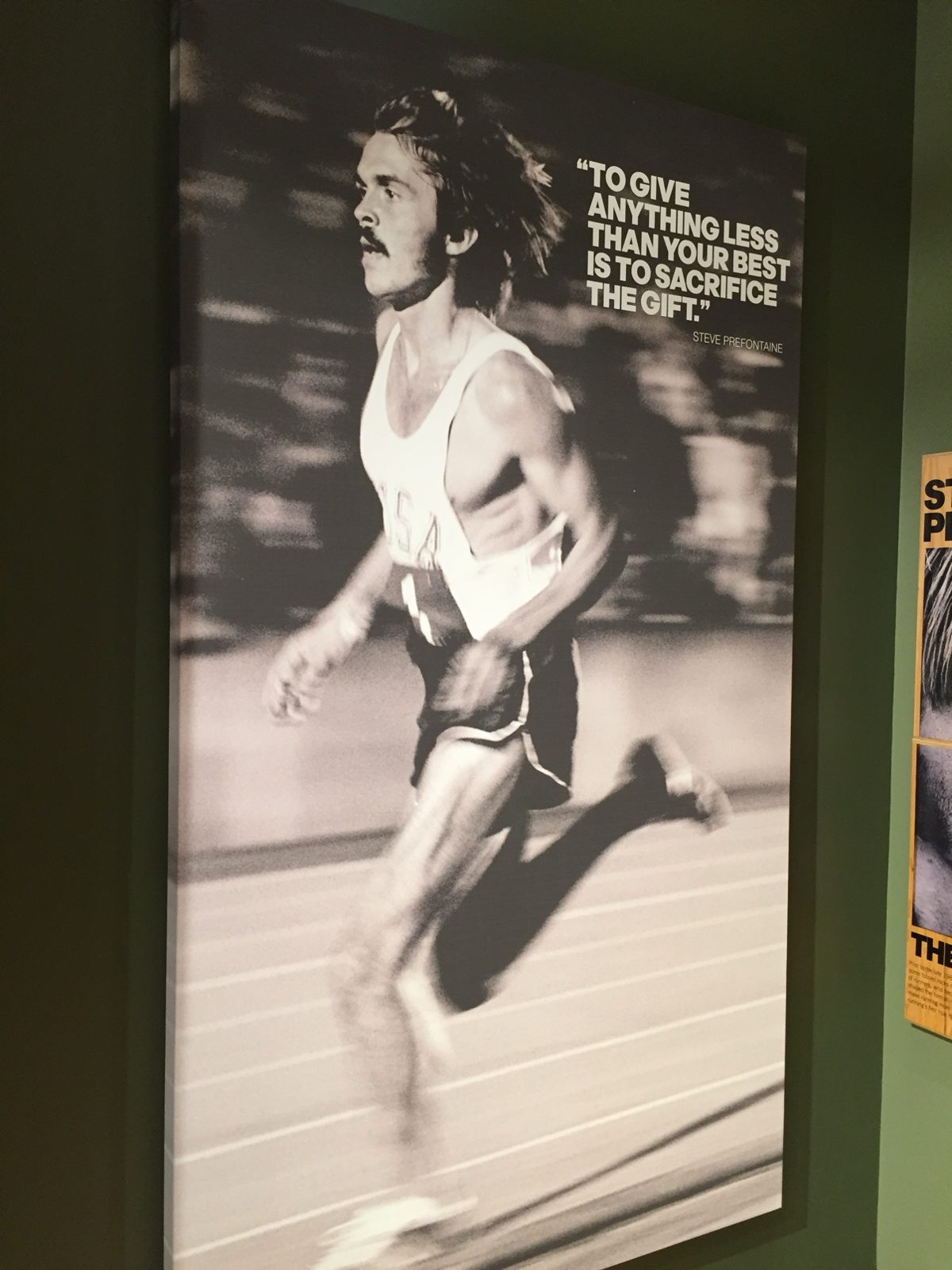
A tall canvas print at the exhibit of Pre running in a USA singlet beside his words: 'To give anything less than your best is to sacrifice the gift.'
2016“To give anything less than your best is to sacrifice the gift.”Photo by Kurt, Nike Headquarters, 2016
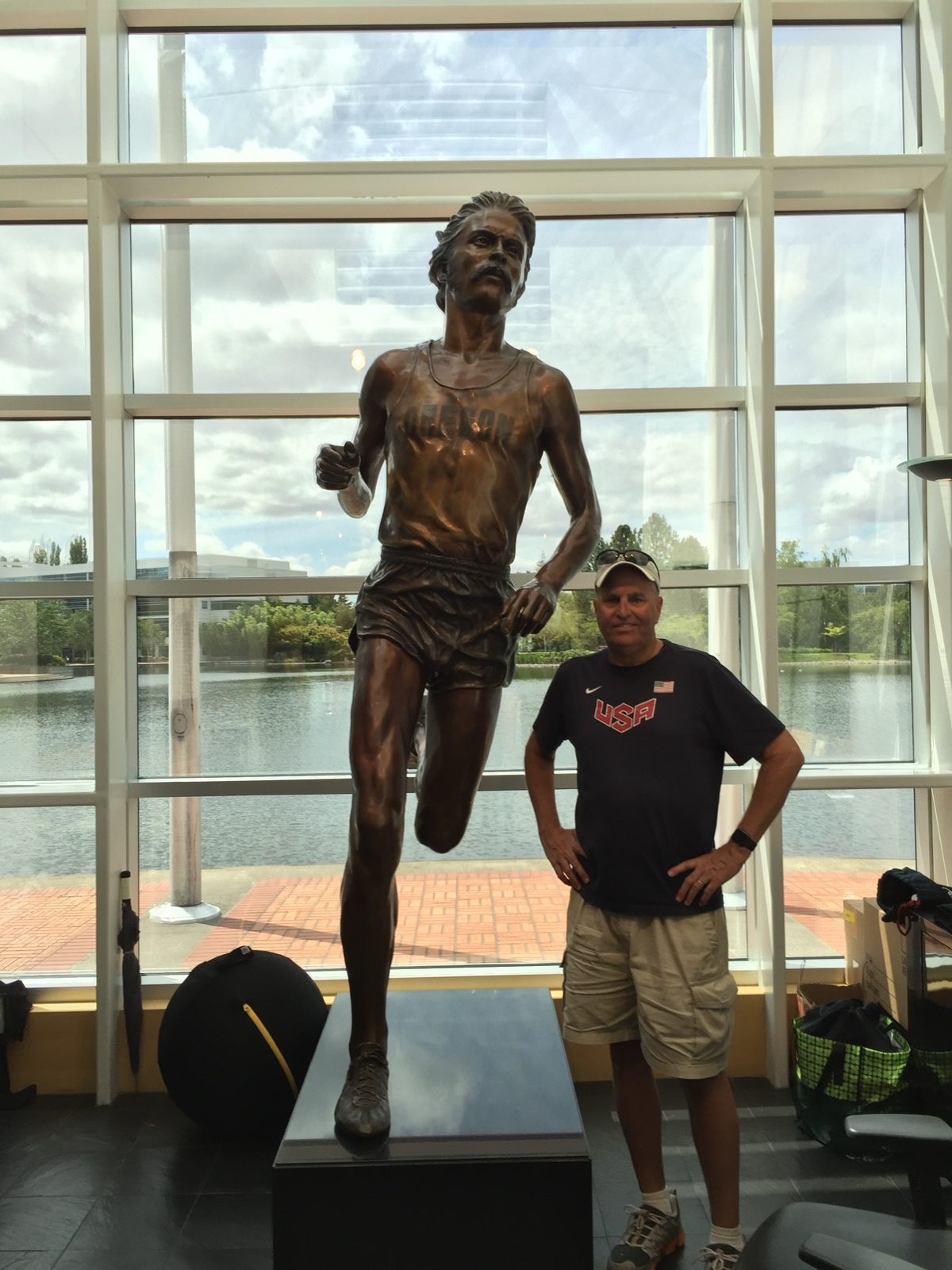
Kurt standing beside the life-size bronze statue of Steve Prefontaine in front of the windows at Nike Headquarters
2016Kurt with the bronze Pre statue at Nike Headquarters.Photo by Kurt, Nike Headquarters, 2016

Why a rock?

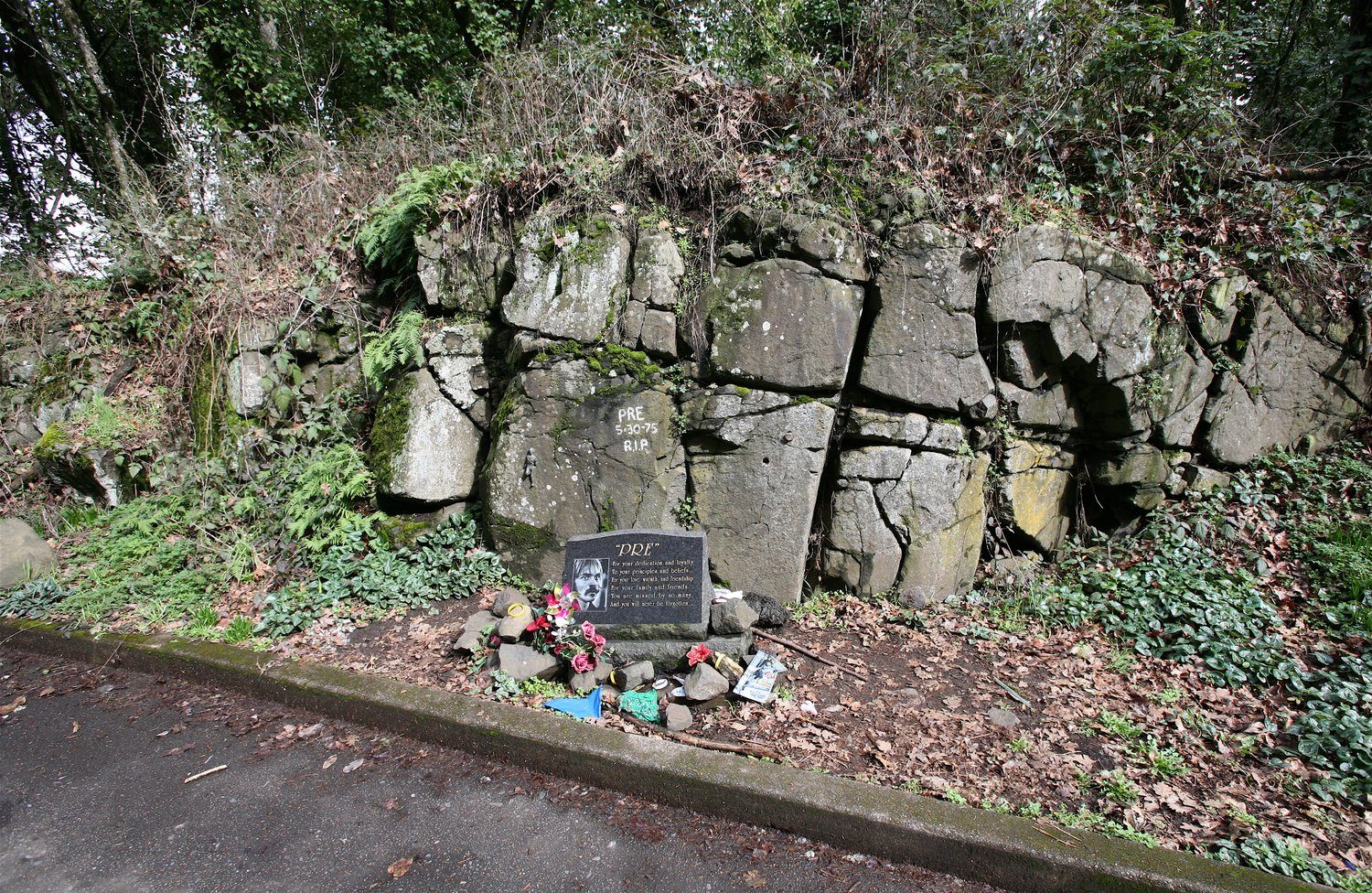
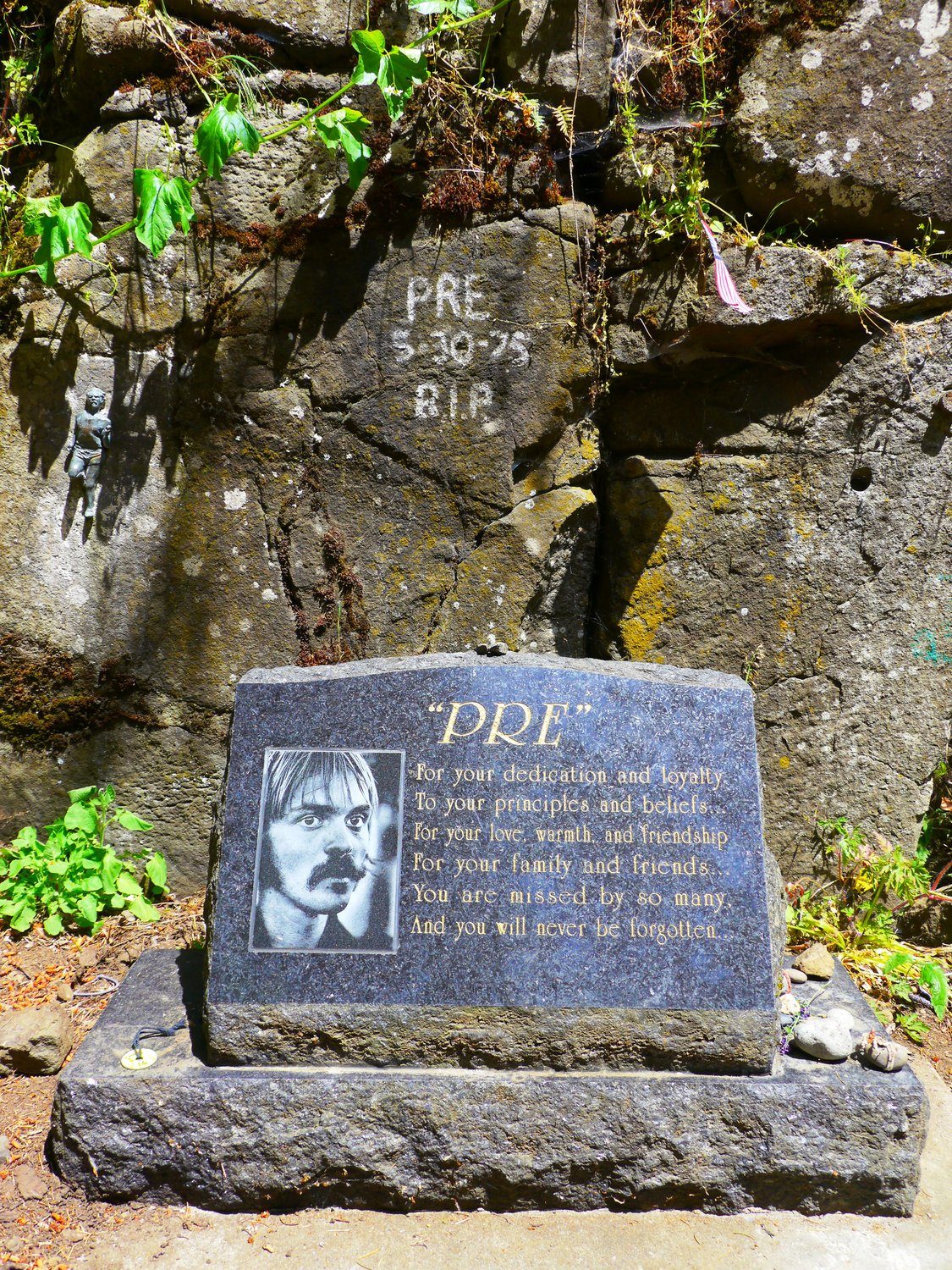
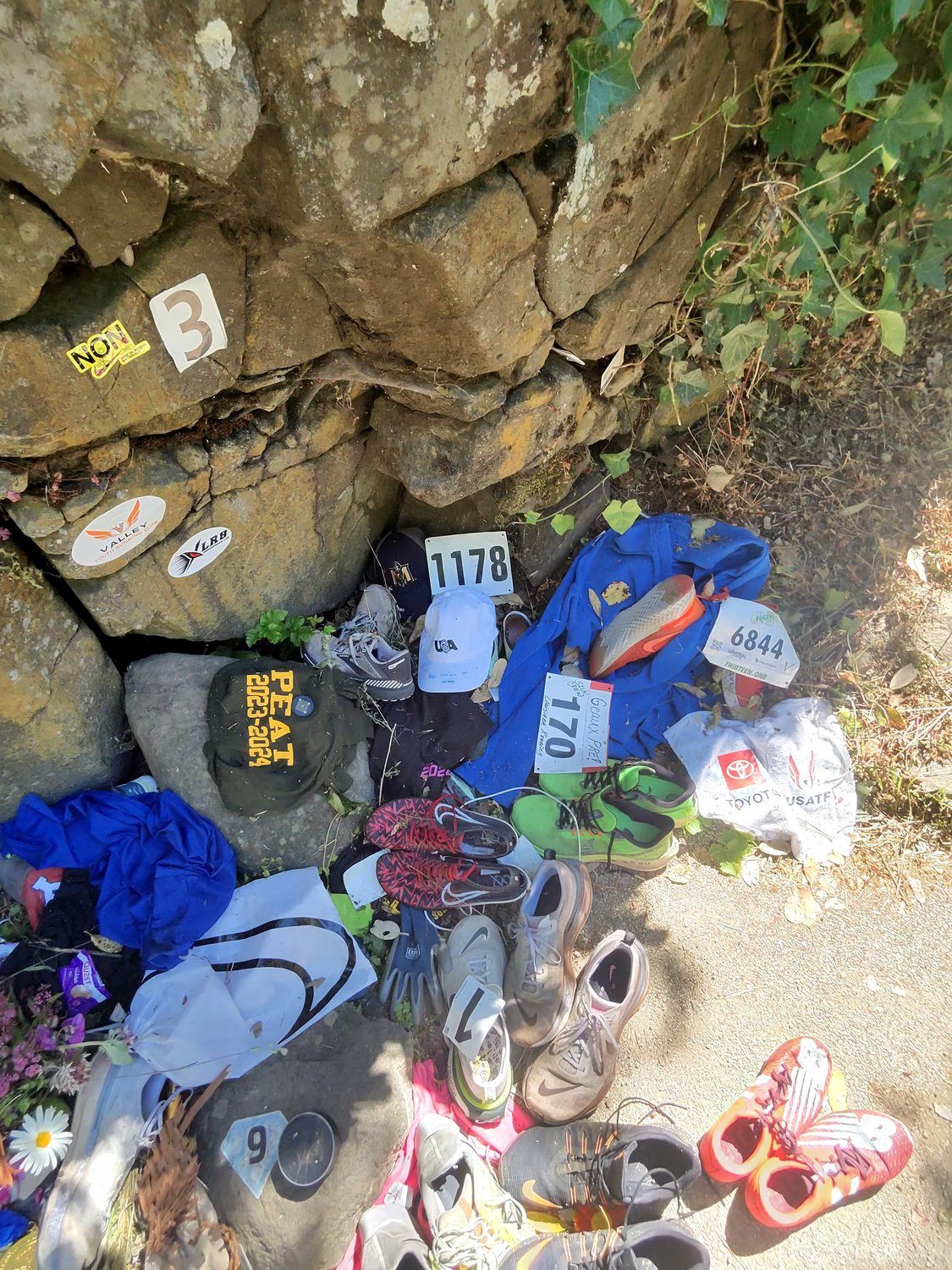
In the early hours of May 30, 1975 — hours after winning his final race at Hayward Field — Pre’s car struck this basalt outcrop on Skyline Boulevard, a short run from the track. The spot became Pre’s Rock, and the pilgrimage never stopped: runners from all over the world jog up the hill to leave race bibs, shoes and medals at the plaque. You can watch the tribute build up, year by year, in the four photos above.

May 30, 1975

The fateful
night

Hours after one last win at Hayward Field, Steve Prefontaine was gone — killed in a car crash on a quiet Eugene road. The basalt outcrop his car struck became Pre’s Rock, and the running world has been making the pilgrimage there ever since.

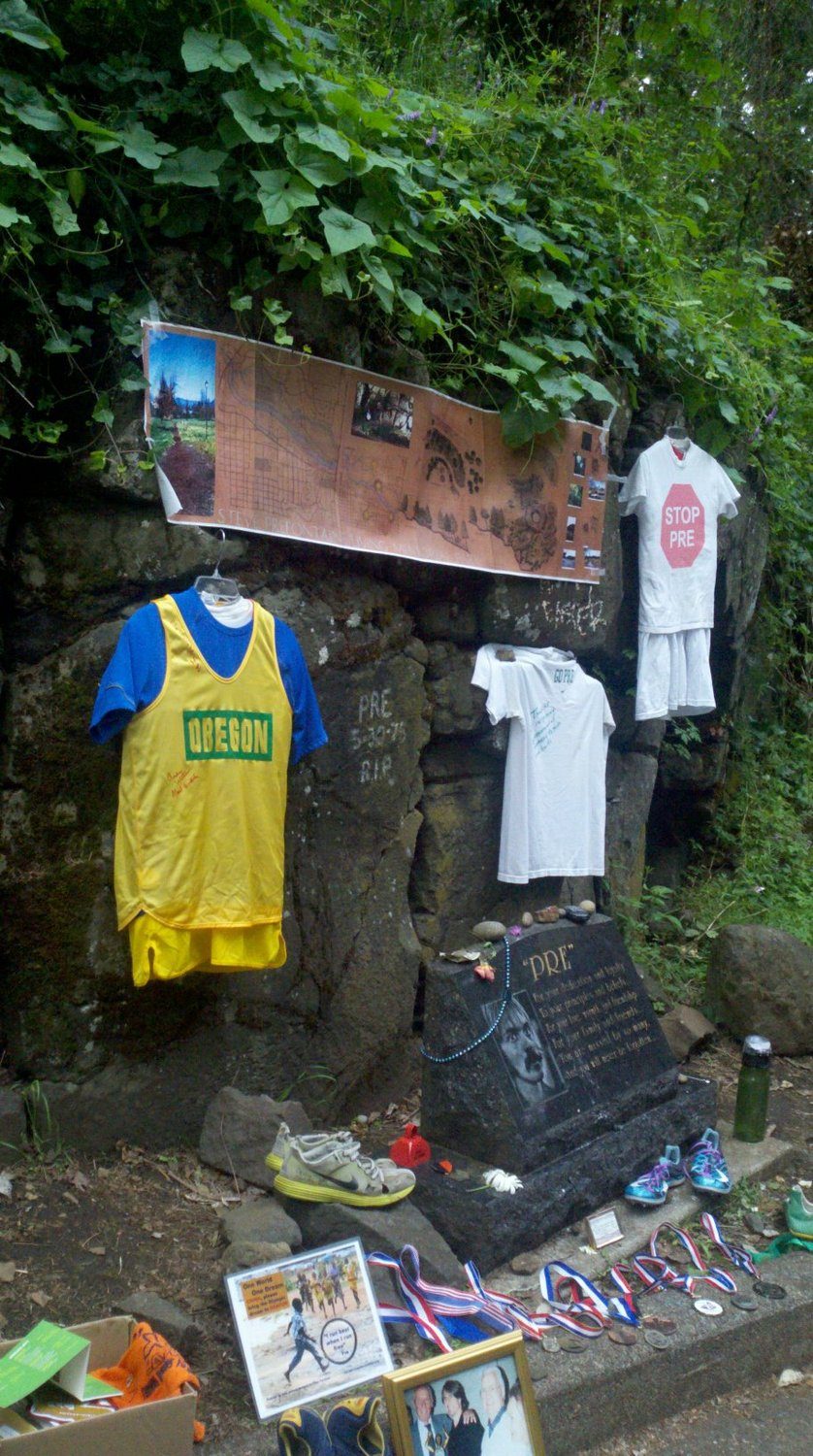
Pre’s Rock during the 2012 U.S. Olympic Trials, covered in singlets, shoes and medals left by runners
Skyline Boulevard • Eugene, Oregon

Pre’s Rock.

A basalt outcrop on a curve above the Willamette River. There is no fence, no gift shop and no ticket — just a plaque in the rock, and whatever the last runners to visit left behind for him.

Open in Maps ↗

Pre’s Rock during the 2012 U.S. Olympic Trials, covered in tributes left by runners. Photo: Piratejosh85, CC BY-SA 3.0, via Wikimedia Commons

One last win at Hayward

On the evening of Thursday, May 29, 1975, Pre did what he almost always did at Hayward Field: he won. Racing at the NCAA Preparation meet against a visiting Finnish team he had helped bring to Oregon, he took the 5,000 metres in 13:23.8 — the final entry in his race log, and you can find it at the bottom of the Results section above. He was 24, unbeaten at Hayward at his signature distance, and planning a summer in Europe and a run at gold in Montreal the next year.

After the meet there was a post-race gathering with the Finnish athletes at the home of his friend and former teammate Geoff Hollister. It was the ordinary, happy end to a Eugene track night — Pre celebrating with the runners he had raced, in the town that had adopted him.

The drive home

Shortly after midnight, Pre left to drive home alone in his 1973 MGB convertible. On Skyline Boulevard, the winding road that climbs through the hills east of campus near Hendricks Park, his car left the road on a curve and struck a basalt outcrop. The car overturned and pinned him beneath it. He died at the scene in the early hours of May 30, 1975, of injuries sustained in the crash.

Eugene woke to the news the next morning. The runner who had filled Hayward Field, who had fought for athletes’ rights and carried American distance running on his back for five years, was gone at 24 — within a short run of the track where, hours earlier, the crowd had chanted his name.

How a crash site became Pre’s Rock

The outcrop was not torn out or fenced off. Instead, a memorial plaque bearing Pre’s portrait was set at its base, and runners began to come — first from Eugene, then from everywhere. They jog up the hill from Hayward, stand quietly at the curve where the road bends past the rock, read the plaque, and leave something behind: a race bib, a pair of worn-out spikes, a medal, a singlet, a note.

Nothing about it is official or curated, and that is exactly the point. The tribute renews itself with every visitor, biggest during Olympic Trials weeks and the Prefontaine Classic — you can watch it build across the years in the Photos section above, from the painted rock of 2007 to the pile of spikes and bibs left at the 2024 Trials. Nearly fifty years on, the pilgrimage Pre never asked for has never stopped.
That night, hour by hour
  • May 29Evening — Pre wins the 5,000m at the NCAA Preparation meet at Hayward Field in 13:23.8, beating the visiting Finnish team. His 152nd and final race.
  • NightA post-meet gathering with the Finnish athletes at Geoff Hollister’s home in Eugene.
  • May 30Shortly after midnight — driving home alone, Pre’s MGB leaves Skyline Boulevard on a curve near Hendricks Park and strikes the basalt outcrop. He dies at the scene, aged 24.
  • AfterA memorial plaque is set at the base of the rock. Runners begin leaving bibs, shoes and medals — a pilgrimage that continues to this day.
  • TodayPre’s Rock stands on Skyline Boulevard, a short run from Hayward Field. The Prefontaine Classic, renamed in his honour, is still run every year at the track he made famous.
13:23.8His winning time in the 5,000m on his final night, May 29, 1975
24Pre’s age — five years after arriving at Oregon as a freshman
152Races in his career log — the Hayward win was the last of them
1975The plaque went in soon after; tributes have been left there ever since

Visiting Pre’s Rock

Pre’s Rock sits on Skyline Boulevard in Eugene, on the curve where the crash happened — a short, hilly run (about a mile and a half) from Hayward Field, and an easy drive. There is no formal visiting area: the rock is right at the roadside, so visitors park carefully, watch for traffic on the bend, and keep stops quiet and respectful — it is a residential street as well as a memorial. Most people simply read the plaque, leave a bib or an old pair of shoes if they brought one, and run back down the hill the way they came. If you go during the Prefontaine Classic or an Olympic Trials week, expect company: you will be joining a line of runners, stretching back to 1975, who all made the same short trip for the same reason.

The Store

Three classics,
one last run.

A small, focused store — the 1975 Oregana yearbook, the Go Pre lanyard, and the 1970 Sports Illustrated cover, plus one limited final run of the Oregon singlet. Simple, secure checkout via PayPal.

Shipping Free shipping in the continental US. International buyers — contact us for a shipping quote before ordering.
✓ Secure checkout via PayPal  •  ✓ Ships from Eugene, OR  •  ✓ Questions? Use the contact form below
Inside the yearbook: the two-page Steve Prefontaine memorial — a full-page portrait of Pre opposite career photos and his memorial service at Hayward Field
2 page Pre Tribute The memorial spread inside the yearbook — a full-page portrait of Pre opposite photos from his career and his memorial service at Hayward Field, where the scoreboard clock was set to 12:36.2.

True Vintage

One of one

Genuine Prefontaine-era pieces — the real thing, not replicas or reproductions. Every item here is one-of-one: when it’s gone, it’s gone.

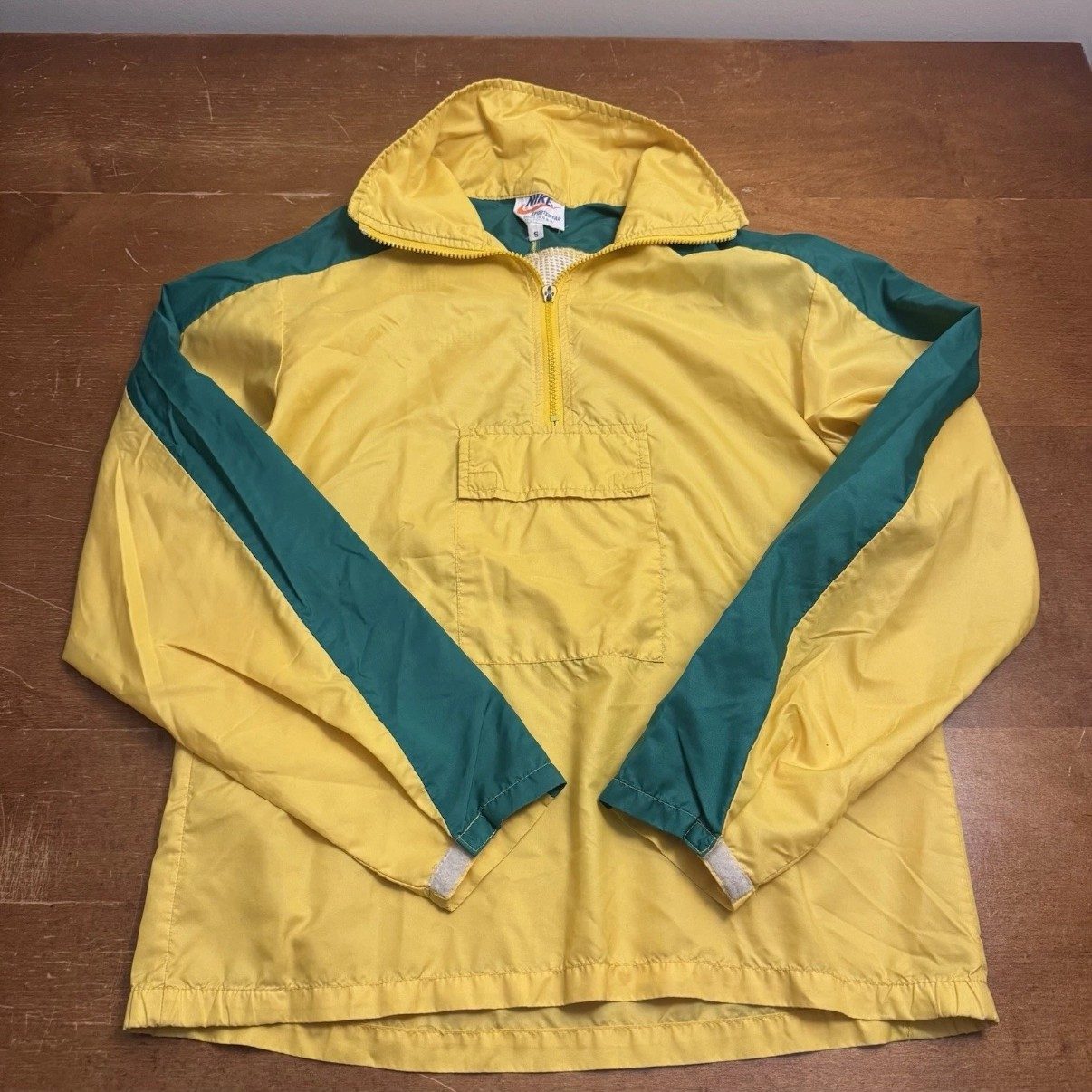
Vintage ’80s Nike Orange Tag Anorak Pullover Windbreaker — Small, Made in USA

Authentic Vintage 1981–1982 Nike Sportswear Orange Tag Pullover Anorak / Smock, in the highly sought-after Pacific Northwest yellow and green colorway. A premium technical piece from Nike’s early outerwear era, featuring a front kangaroo pouch with Velcro closures, Velcro wrist cuffs, and a vented mesh upper back.

Classic boxy, cropped 1980s athletic fit that sits perfectly at the waist. 20″ pit-to-pit; length 26″ from back of neck to bottom hem (29″ with collar flipped up) — fits like a true vintage Men’s Slim Small or a Women’s Medium. “Oregon Ducks Colorway” / “Seattle Sonics Style.” From a smoke and pet free home.

Condition — please readPlease note: the hood is missing, and the YKK zipper pull is broken off (the zipper itself still moves up and down). Nearly 50 years old — please ask all questions prior to purchase, as returns are not accepted.
$89.00

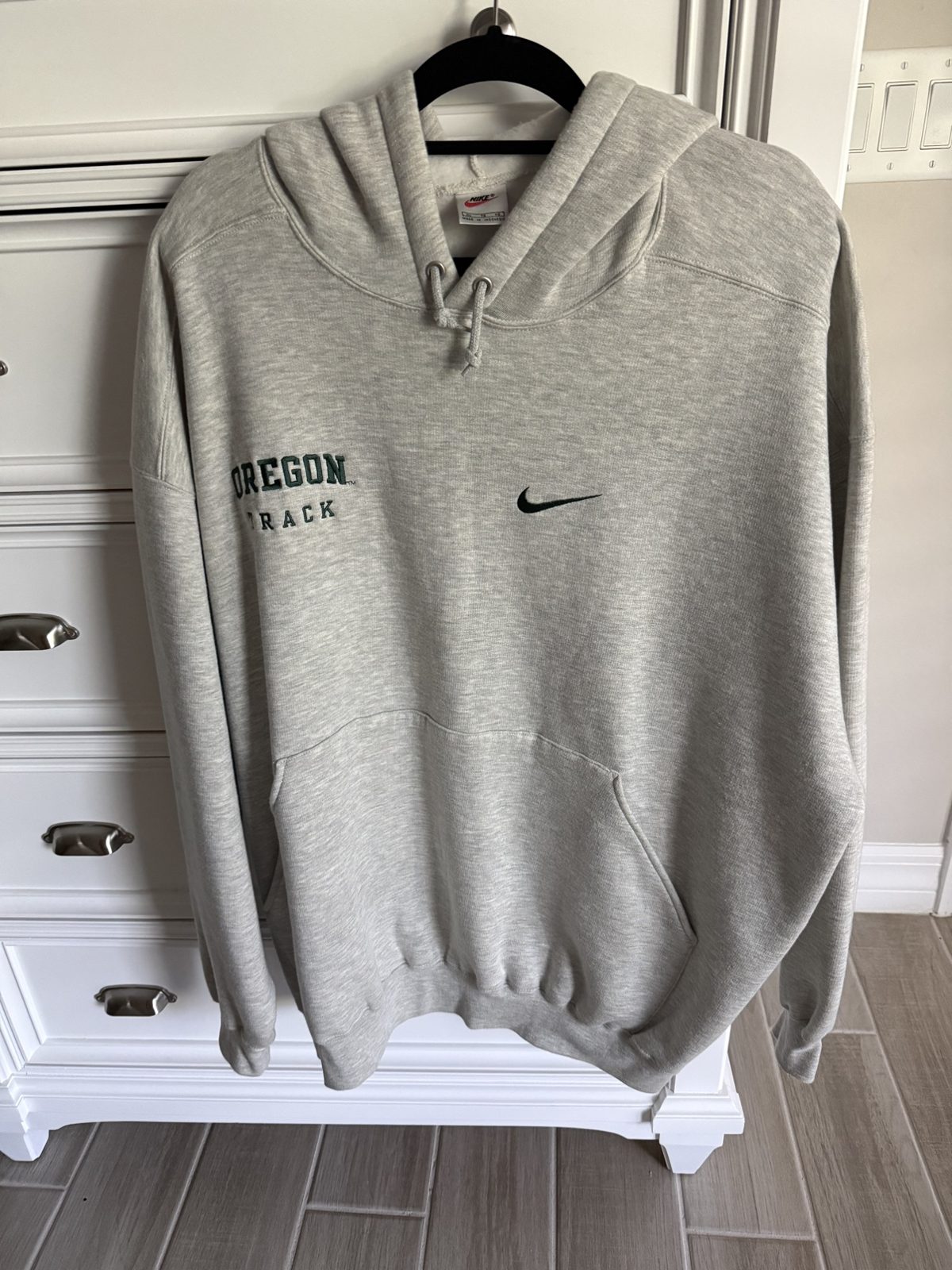
Vintage Y2K Nike Center Swoosh Oregon Track Hoodie — Grey, XL, Mint

True vintage, MINT. Vintage Y2K Nike Center Swoosh Oregon Track Hoodie, Men’s XL (fits true to size / relaxed fit). Heather grey with forest green and black embroidery. Heavyweight 80% cotton / 20% polyester blend. The iconic Nike “Center Swoosh” layout paired with the classic early-2000s silver/grey tag with the red Nike logo — spotlighting the historic Oregon Track & Field program, with high-quality dense embroidery rather than cheap screenprint. Measurements (laid flat): pit to pit 29 inches; length (top of shoulder to bottom hem) 29 inches. Ships fast and clean from a smoke-free home — feel free to reach out with any questions.

Condition — mint / deadstockCollector-grade condition. Zero fading or discoloration; flawless cuffs, waistband, and neckline with no stretching, fraying, or pilling; kangaroo pocket tight and crisp; drawstrings fully intact with neat aglets.
$119.00
Contact

Say hello.

Questions about an order, a product, or a Pre story to share? Fill this in and it opens your email ready to send.

GoPre

A fan-run tribute and memorabilia store for Steve Prefontaine. We answer product questions, order help, and Pre stories people want to share.

Best forOrders, product questions, tribute submissions
CheckoutPayPal — no account needed to pay by card
RequestsLooking for a Pre item you don't see here? Ask — the store grows one product at a time.
Ready to send — your email app should open with the message filled in. If it didn’t, copy the text below.
Added to cart